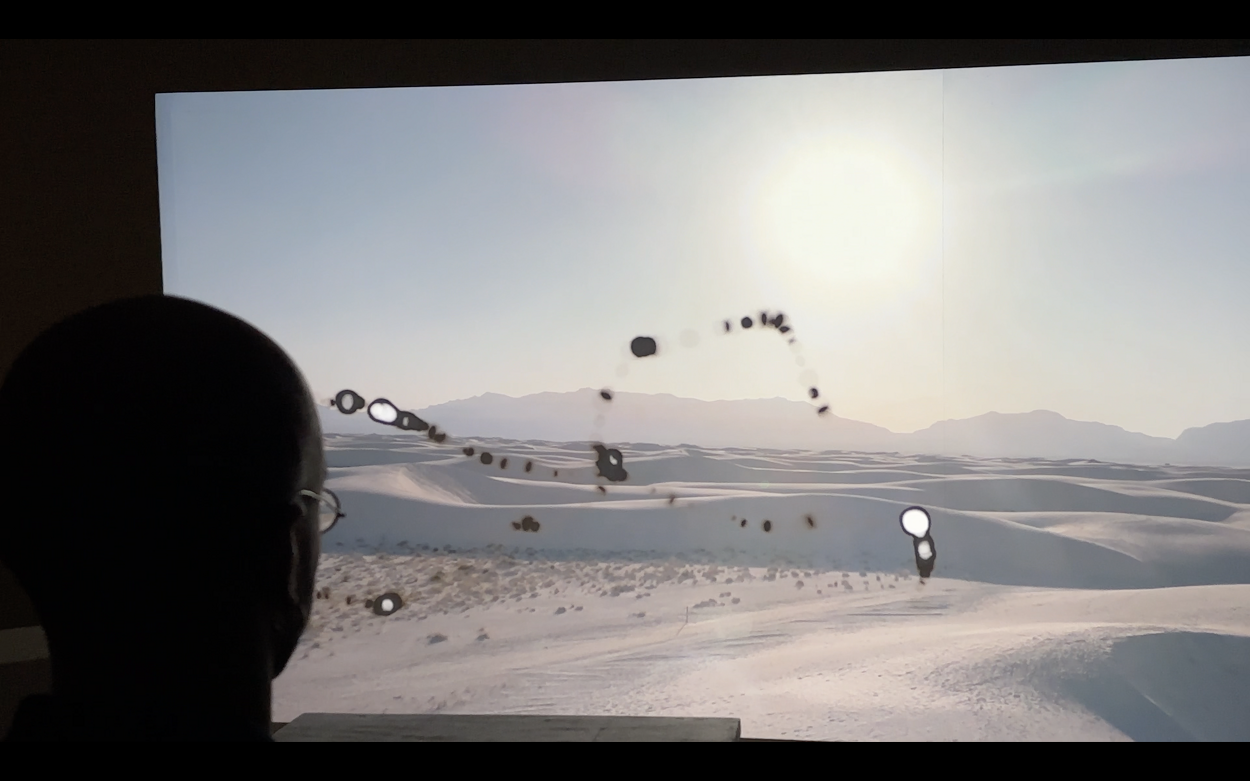
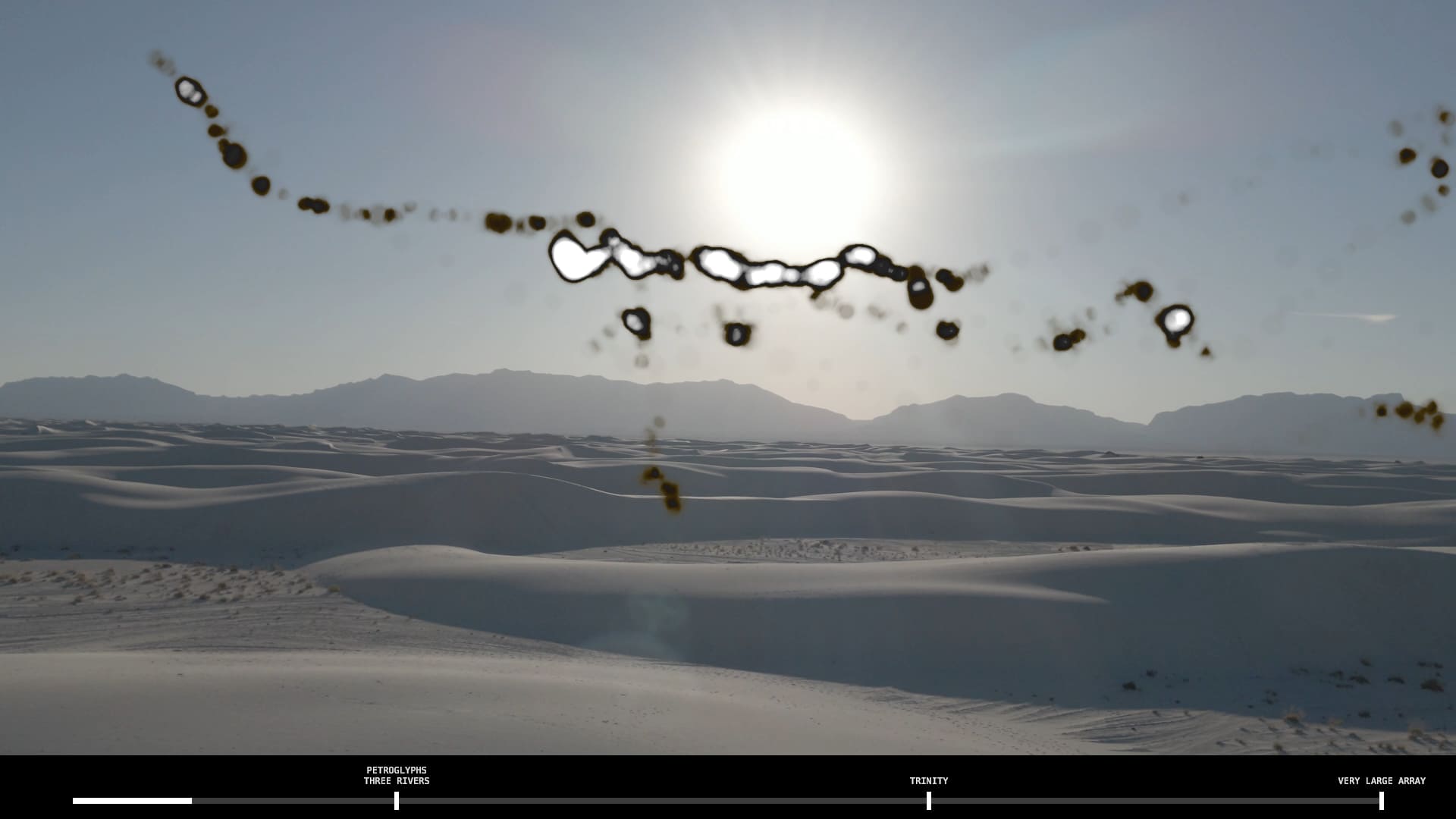
Where the Sun Never Setsinvites visitors to go through a territory where nuclear memory, sky observation, and narratives of resistance intersect. Through the gaze, transformed here into an exploration tool, each person charts their own path through the work. The installation offers a sensory experience of our relationship with radiation – solar, atomic, and cosmic – and the traces it leaves behind in both physical landscapes and collective imaginations.
Featuring testimonies from : Tina Cordova, co-founder of the Tularosa Basin Downwinders Consortium Timothy Mousseau, biologist specializing in the effects of radiation Katherine Spies, NASA astronaut Members of the Tularosa Downwinders community (New Mexico) Jim Martinez, specialist in the Chihuahuan Desert and president of the Chihuahuan Desert Institute ; Joan E. Price, research associate at the Jornada Research Institute and specialist in the Three Rivers petroglyphs.
At the heart of the installation, an eye-tracking system turns the visitors' gaze into a navigation interface. Eye movements activate audio fragments, revealing singular narratives. Each experience generates a gaze map (heatmap) archived on an online platform – accessible via QR code – joining an ever-evolving collective memory. The installation thus combines documentary inquiry, an interactive system, and a living archive to make perceptible the histories and realities that stand in counterpoint to dominant narratives.
The project was born out of a research conducted in New Mexico around three iconic locations : the Three Rivers Petroglyph Site, the Trinity Site – where the world's first atomic bomb was detonated – and the Very Large Array, a radio astronomy observatory dedicated to exploring the cosmos. Together, these three sites map out a single narrative connecting solar, atomic, and cosmic radiation. Over several months, interviews were conducted with scientists, local residents, and activists from the Tularosa Basin Downwinders Consortium. These testimonies were then woven together with video and sound recordings captured across the various research sites.
With the support of : Villa Albertine, the MIRA program of the Institut français, and the University of Évry SIANA.
Élise Morin develops an interdisciplinary research-creation practice at the interface of art, science, and territories. Her projects rely on experimental apparatuses and transdisciplinary collaborations to question regimes of visibility, modes of coexistence, and the place aesthetics in the production of situated knowledges. Trained in Paris, London, and Tokyo, she lives and works in Paris.