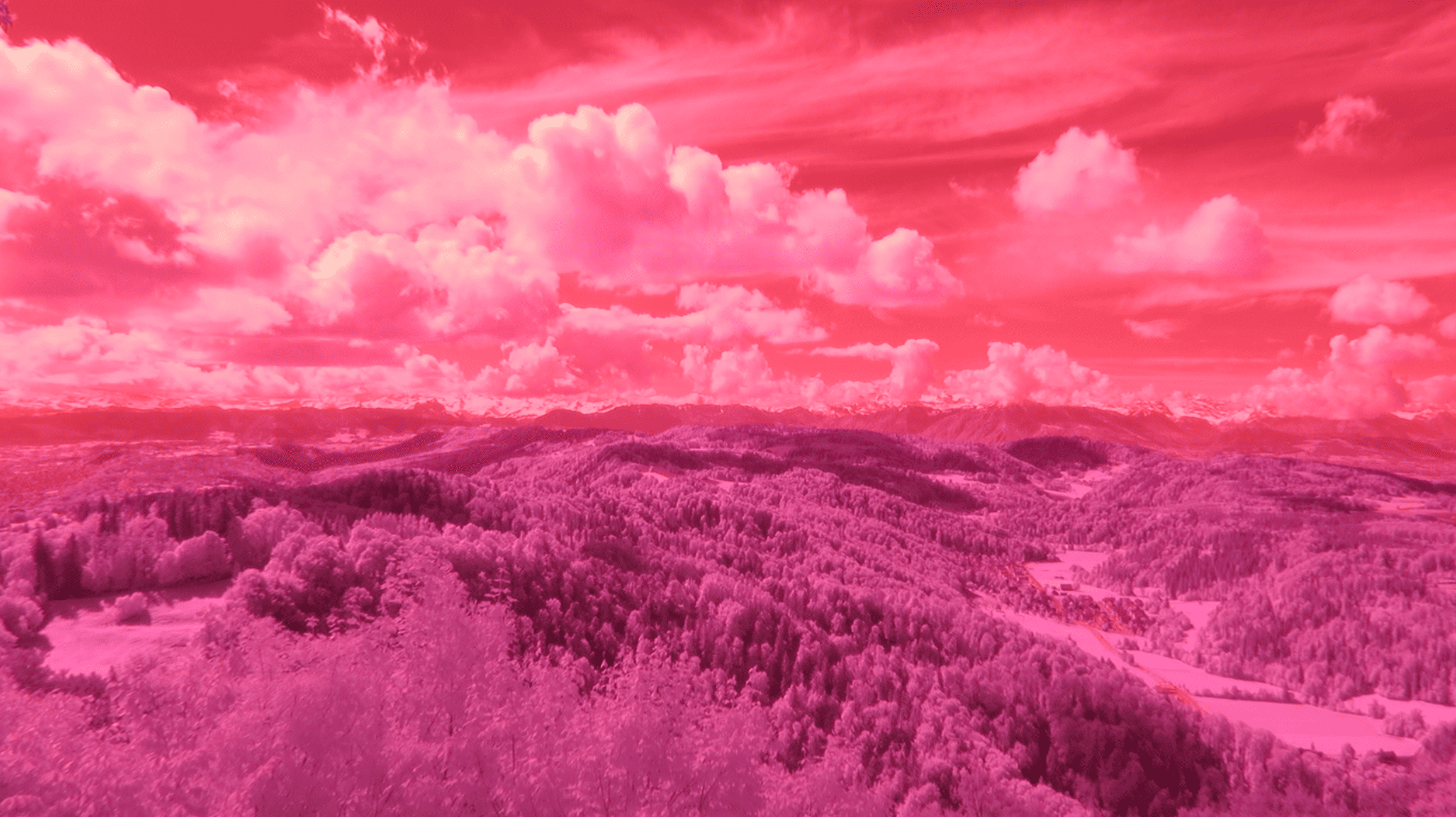
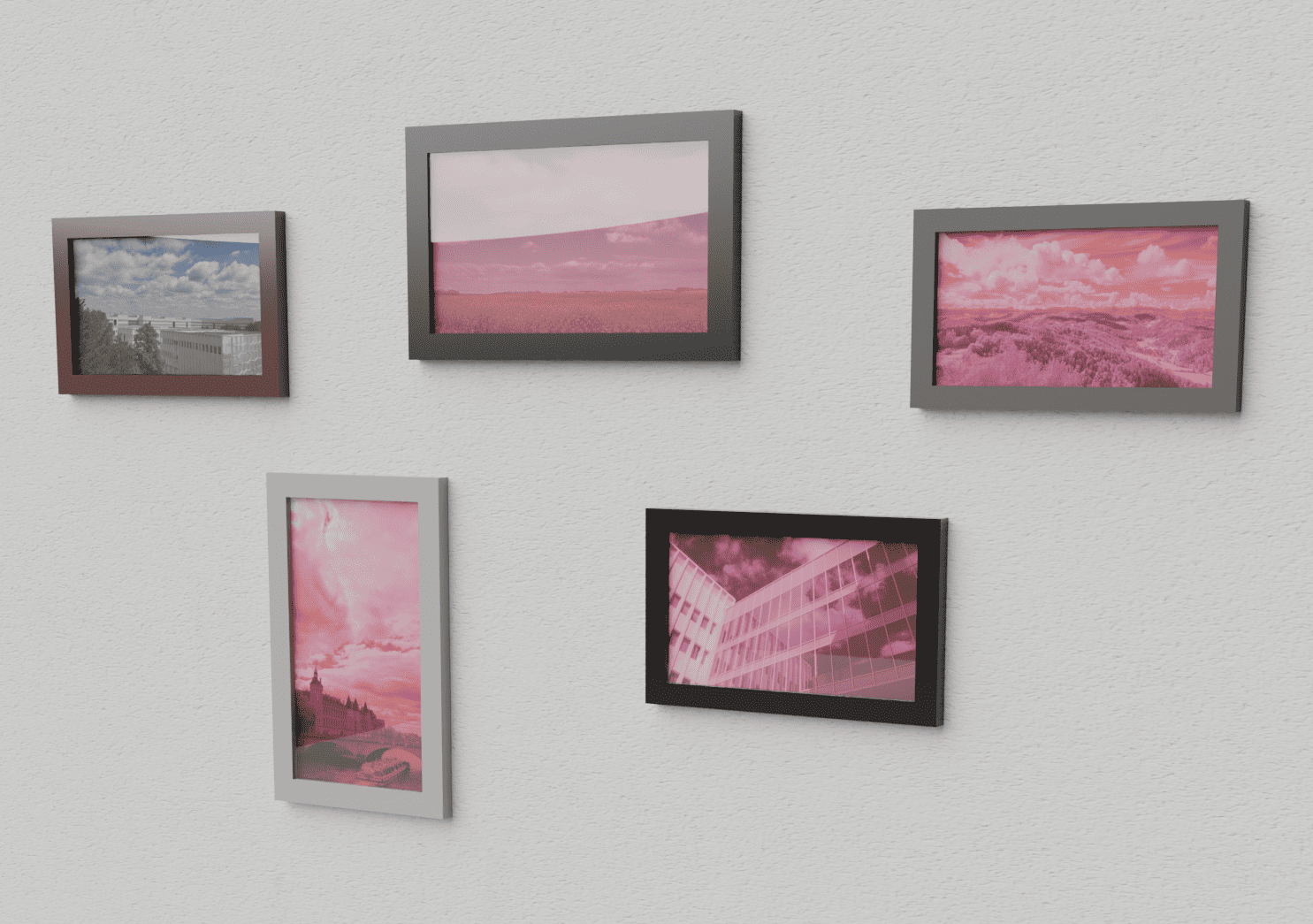
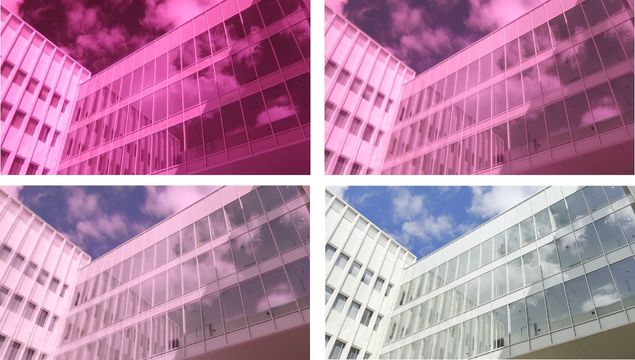
Redshiftis an interactive video installation that invites visitors to discover the world as it appears in infrared (IR) light. Presented as a polyptych on a variable number of screens, the work stages pairs of natural and urban landscapes recorded simultaneously in the visible spectrum (~380–750 nm) and in the near infrared (~750–1400 nm). The two videos in each pair merge into one another, with the blending rate varying according to viewing distance: when a visitor·euse stands far from the screen, only the IR image is visible. As they approach, the image gradually transforms into the corresponding video in visible light. Moving away reverses the transformation. This colour-shift effect, linked to the relative position and movement between observer and observed object, is described by the physical concept that gives the installation its name: redshift. In astrophysics and cosmology, redshift refers to the phenomenon by which light (or any electromagnetic radiation) shifts toward longer wavelengths. In the visible spectrum, the longest wavelengths correspond to red—hence the name.
The artwork illustrates a philosophical idea about the nature of perception: our understanding of objects is not fixed, but conditioned by our relationship to them, and potentially enriched when we begin to move and explore the space in which we find them. Redshift also seeks to explore the question of how the point of view (subjective and spatially situated) of spectator·ices can be integrated into a video work that is usually static. If our human eyes do not allow us to see infrared, technology — such as simple photographic sensors — can give us access to this world, revealing plants with mysterious glows, ethereal clouds, and a luminous and unfamiliar colour palette. None of the videos — neither the visible light nor the infrared one — has been retouched in post-production. The colours were determined by the automatic white balance algorithm of each camera.
The conceptual starting point of Redshift is a thought experiment: what would happen if the sky receded? In such a scenario, visible light would shift toward red, and even beyond, into the infrared spectrum, imperceptible to the naked human eye. Redshift is a relativistic phenomenon and, as such, imperceptible in everyday experience. The closest common equivalent is the acoustic Doppler effect: the familiar change in perceived pitch of an ambulance siren as it passes. The “real” pitch of the siren—such as it would be perceived by someone moving at the same speed—differs from that heard by any stationary listener. The installation raises an analogous question about vision: what is the “real” colour or appearance of a landscape?
Tim Schneider
Tim Schneider was trained in high-energy physics and holds a PhD in radiotherapy and hadrontherapy. Having moved toward the field of art-science, his research at Université Paris-Saclay is now focused on immersive installations in open spaces and on the study of new approaches for tracking systems of people and movement. In addition, he is a member of the collective Le sas, where he mainly works on the creation and development of interactive digital art works and experiences.