
1 La métonymie, Le sas · 2 BioMaps, Université Paris-Saclay, CEA, CNRS, Inserm · 3 Forum des images · 4 Cervval · 5 Institut d’Astrophysique Spatiale, Université Paris-Saclay, CNRS · 6 Institut d’Alembert, Sorbonne Université, CNRS
Extended abstract presented at the 2nd IFAC Workshop on Control of Complex Systems (COSY 2025), Gif-sur-Yvette, 30 June – 2 July 2025.
The Eye of the Sun, Nuit Blanche, 1 June 2024, Musée des Arts et Métiers, Paris
At La Nuit Blanche 2024, visitors discovered The Eye of the Sun, a giant eye that stared at them and followed them. It was curious about them, inviting them to come closer to touch it and unveil what was hiding inside. The Eye appeared to the visitors as an autonomous agent and naturally invited engagement and interaction. Here, we briefly present the technology and control systems involved in The Eye and open up connections towards user experience studies around immersive, interactive artworks.
The Eye of the Sun (Figures 1 and 2) is an art-science work about the invisible radiation coming from the solar corona, measured in the extreme ultraviolet range. It relies on multi-user infrared and multi-touch sensing with spherical video projection and spatialized sound controlled by a central computer and graphics processing units. It is made of aluminium and acrylic.
1.1 Concept
The Eye of the Sun is a gigantic eye with a realistic aesthetic. It is the size of a human, spherical, white and vascularized. It is connected to the surrounding world by an electric optic nerve. It has its own behaviour, similar to that of a human eye. The Eye observes and follows visitors as they pass by and approach (Figure 1). The Eye responds to the curiosity of some visitors by showing them the Sun in the extreme ultraviolet range, which we cannot otherwise see (Figure 2).
The Eye of the Sun is a motion and touch sensitive digital sculpture consisting of two 1.7 m diameter hemispheres that act as a spherical screen for two on-board video projectors. The installation is a play on curiosity. It seeks to redefine the relationship between experiencers and artwork. On arrival, visitors find themselves face to face with a giant human-like eyeball (Figure 1) that looks back at them, periodically blinking, squinting or changing its iris colour, and following visitors around as they move and walk around The Eye. The result is a reversal of the established roles: it is now the artwork that is curiously watching the human visitor.
When curiosity is returned and the visitor performs the right gesture, The Eye opens to reveal its interior: an interactive simulation of the surface of the Sun, showing images of the solar corona captured at different extreme ultraviolet wavelengths by NASA’s Solar Dynamics Observatory satellite (Patel, 2024).
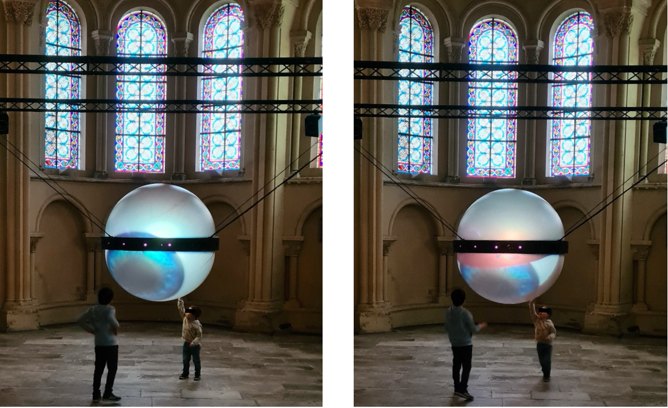
Figure 1. Young users interacting with The Eye (left). The Eye squints after being touched (right). The Eye of the Sun, Museum of Arts and Crafts, Paris, France, 2024. © 2024 La métonymie.
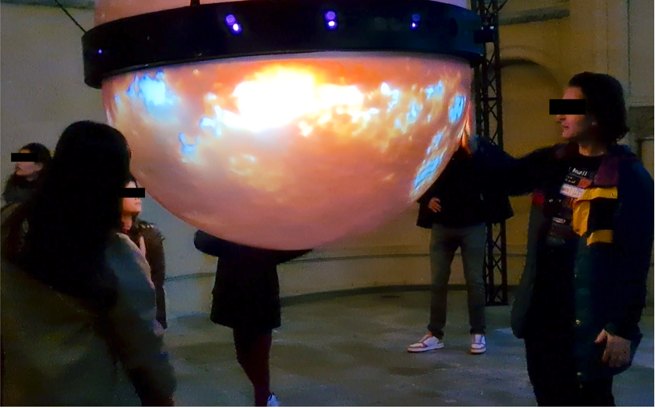
Figure 2. In one of the scenarios of The Eye of the Sun (Maître et al., 2019), experiencers explore the surface of the Sun at different extreme ultraviolet wavelengths and cause coronal perturbations when they touch the surface of the sphere. Museum of Arts and Crafts, Paris, France, 2024. © 2024 La métonymie.
1.2 Setup
The two acrylic hemispheres on which the images of The Eye or the Sun appear are connected by a 15 cm thick central technical disc, which houses the two video projectors alongside the necessary optical equipment (lenses and mirrors), a network router, a sound card, and several power supplies and cables. In addition, 16 infrared cameras, 8 loudspeakers and several ventilation fans are positioned around this technical equator. Along the light path (Figure 3), each video projection system consists of:
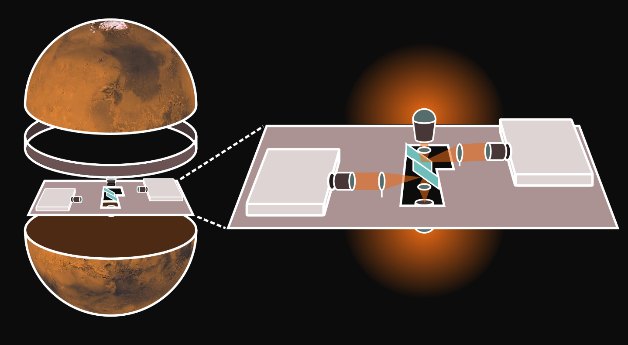
Figure 3. Schematic representation of the technical structure of The Eye of the Sun (the surface of Mars is shown instead of the Sun’s corona). The two projection hemispheres are represented along with the equatorial technical disc positioned between them, with the optical system that allows simultaneous video projection on the two hemispheres.
The 16 infrared cameras point outwards from the equator to capture a panoramic view and to detect motion around The Eye at 30 Hz (Figure 4, bottom). The 8 loudspeakers provide spatial sound effects when The Eye blinks, squints, moves or when specific interactions with the experiencers occur. Finally, two additional wide-angle infrared cameras are installed centrally on either side of the equatorial disc to detect the hand through the semi-transparent hemispheres when it is touched by the experiencers (Figure 4, top). Hand detection is performed using a custom-trained version of the YOLOv8 algorithm (Varghese & M., 2024). This enables multi-touch interactions with The Eye, in particular, with the Sun where experiencers can trigger ripples on the solar surface (Figure 2, right), trigger coronal mass ejections or swipe between wavelengths. User recognition, interaction, graphics and audio are controlled by dedicated Python, C# and OpenGL code running on a Dell Precision 7920 workstation equipped with an Nvidia Quadro A4500 graphics card. The workstation is located a few metres away from The Eye and connected to it via two RJ45 cables for audio and video streams.
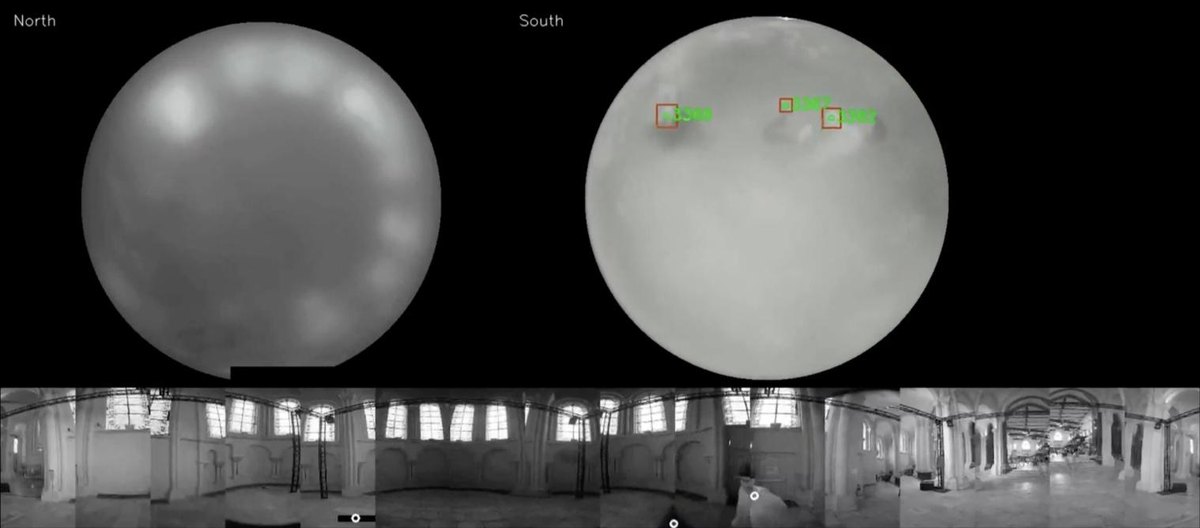
Figure 4. The different camera inputs of The Eye. Top: inside views of the Northern and Southern hemispheres; three hands/touches are detected in the South. Bottom: 360-degree view around The Eye; small white circles indicate detected motion clusters.
As part of the European project Artcast4D, The Eye of the Sun was included in a comparative field study together with three other experiences of varying degrees of immersivity in (1) virtual reality (VR), (2) 360-degree video projection setup, and (3) floor and wall video projection in a public space. Subjective user experiences were assessed for each installation using a questionnaire that primarily addressed the spatial presence in immersive environments (Khenak et al., 2019). The questionnaire was completed by 61 volunteers. While a detailed presentation of the results is beyond the scope of this extended abstract, it may be summarised that participants reported a high affordance and perceived realness when interacting with The Eye, leading to an overall comparatively high sensation of immersion.
The Eye of the Sun is where art and science meet. It challenges visitors’ curiosity and plays with their emotions and reasoning. It also challenges the demands of immersion, as visitors are not immersed in the artwork. They see it from a distance. They move around it. Sometimes they touch it. With its unique setup and interaction capabilities, it provides an interesting test ground for studying user experiences around immersive and interactive artworks.
The comparative field study was funded by the European Union’s Horizon Europe research and innovation programme as part of the Artcast4D project, www.artcast4d.eu (grant agreement No 101061163).

Extended abstract (pdf)
