
1 Cervval · 2 La métonymie · 3 Le sas · 4 BioMaps, CEA, CNRS, Inserm, Université Paris-Saclay
Poster presented at the JIT 2026 – Journées d’Informatique Théâtrale (Theatre Computing Days), Université Paris 8, Saint-Denis, 7–9 October 2026.
The abstract and the poster (downloadable at the bottom of the page) are in French; the text below is an English translation.
In an intimate entanglement of painting, music and technique, real-time capture of a 3D virtual stage allows digital imagery to be inserted without constraint onto the stage of the Auditorium du Louvre in Paris. Around Leonardo da Vinci’s painting and through an interactive technical set-up, freedom of light play and of the musicians’ play is given on stage through a joint human–machine construction of the performance.
In November 2019, the Doulce Mémoire ensemble, directed by Denis Raisin Dadre, was invited to commemorate the five-hundredth anniversary of Leonardo da Vinci’s death at the Auditorium du Louvre, in connection with the exhibition organised by the Musée du Louvre around the paintings it holds by this Renaissance artist and researcher [2].
2.1. Musical creation
On the lira da braccio, Leonardo da Vinci improvised to accompany the sung recitation of poetry. This practice, free of any rules, made it a privileged field for sound experiments.
Throughout the performance, The Hidden Music of Leonardo, the lira creates a strange halo of sound which, according to Vincent Delieuvin, curator of the exhibition, recalls sfumato, the pictorial technique Leonardo developed to soften outlines. The sound of this instrument raises the question of whether playing it helped Leonardo to win a certain freedom in drawing and painting.
Listening to the music chosen by Denis Raisin Dadre [3], exactly contemporary with the conception of the paintings, one realises that music – present throughout Leonardo’s life, and whose ephemeral nature troubled him – runs through his entire work.
2.2. Digital creation
The digital creation starts from a hypothesis both imaginary and somewhat anachronistic: painting is born of music. The stage the audience discovers is an all-white canvas of which the musicians, dressed in white, are an integral part. At the first note of music, the first colour – the deep blue of the sky – is the first touch of paint (figure 1). Among all those that follow, among all these possibilities, a choice is made and the pictorial work materialises.
In the spirit of Daniel Arasse, it is through detail that we enter Leonardo da Vinci’s painting. The aim is not to unveil the work but rather to present to the audience, whole, the mystery, the complexity and the research carried by all of Leonardo’s work. The visual and digital creation lets the audience explore for themselves both Leonardo’s painting and the music associated with it.
3.1. Guiding principles
The visual creation relies on the following main elements:
3.2. Physical stage
On the stage of the Auditorium du Louvre, the three projection surfaces were a grey floor mat of (8 × 4) m2 on which the musicians moved, a backdrop screen of (9.20 × 4.90) m2 and the musicians’ white costumes. The stage was surrounded by 16 sensors (Kinect® One), each controlled by a mini-PC (Shuttle XPC nano NC3000BA). Evenly spaced on stands 40 cm in front of the stage and 80 cm on the sides and at the back, they covered the whole stage. The lighting plan relied mainly on side profile spots on stands, to preserve the video projections. Two front and back lines of plano-convex spots also supported the lighting of the musicians. The sensors’ depth maps were sent over the network to a workstation (Dell Precision 7820) at the control desk.
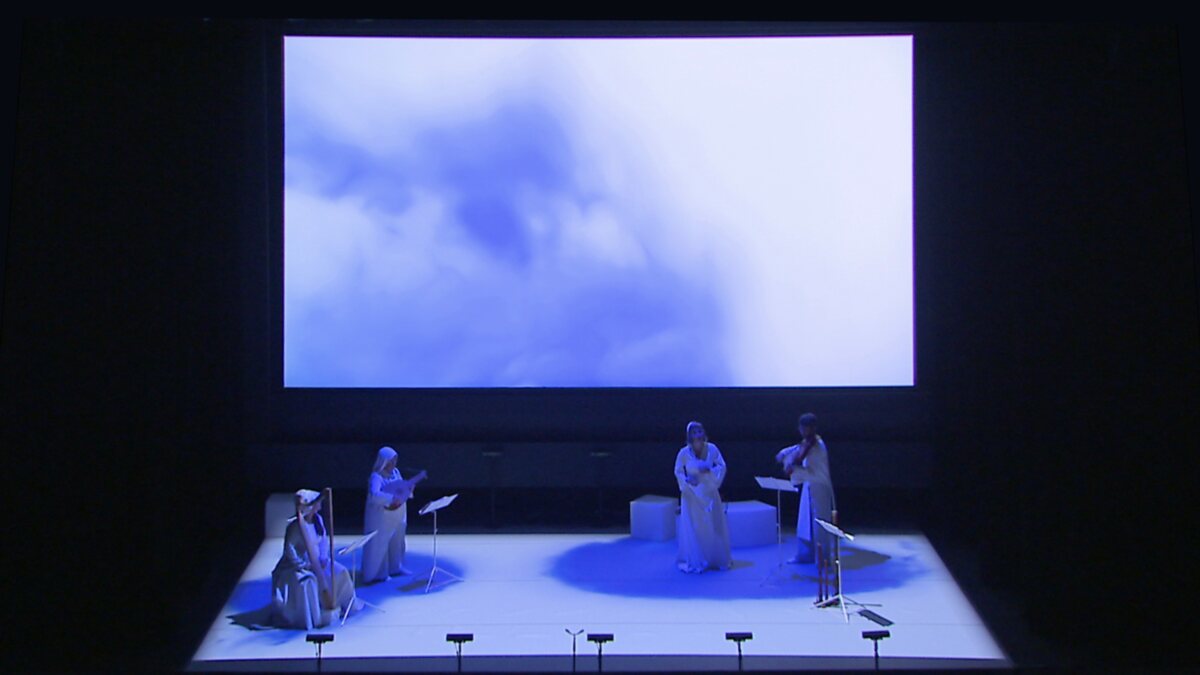
Figure 1. Capture of the virtual stage (5 of the 16 front sensors are visible) and the first scene of deep blue that each musician brings on stage, uncovering the cloudy sky projected on the floor and continuously on the backdrop.
3.3. Virtual stage
The depth maps were calibrated on the overlaps of the sensors’ fields of view, recorded as an operator walked through. They were then merged into a single virtual reference frame, rendering the 3D silhouettes of the six musicians in real time with a precision usable for the performance. Before the show, this virtual stage was registered to the real stage of the Auditorium with two digital grids projected by the two video projectors, one covering the backdrop and the musicians, the other the stage floor. Three sets of 2D masks could then be extracted from the 3D virtual stage to project (or avoid projecting) onto the backdrop, the musicians and the floor. The 3D virtual stage and the 2D masks were developed in C# and OpenGL.
In line with Klaus Obermaier’s work on Apparition or Chunky Move’s on Glow [1], we aimed to cover the musicians, the floor and the whole stage with video-projected light, no longer from a single viewpoint (2D rendering) but from multiple viewpoints (3D rendering). With only two video projectors, and side lighting mainly for the faces, there was no (or almost no) shadow area over the whole stage. The six musicians were captured and video-projected at every point of the stage, whereas in Apparition capture and projection were limited to a triangle marked on the floor so that the two dancers could tell at any moment how far they were caught in the projection.
A 3D virtual stage such as this one imposes a priori no constraint on the number and position of the performers (musicians, dancers or actors), within the limits of occlusion.
By computing a 3D virtual stage of the musical performance in real time, we can play with the perception of space and project either indiscriminately or exclusively onto the bodies of the six musicians, the floor and the backdrop. Technically and artistically, it was a challenge whose stake could be an entirely different way of lighting live performance.
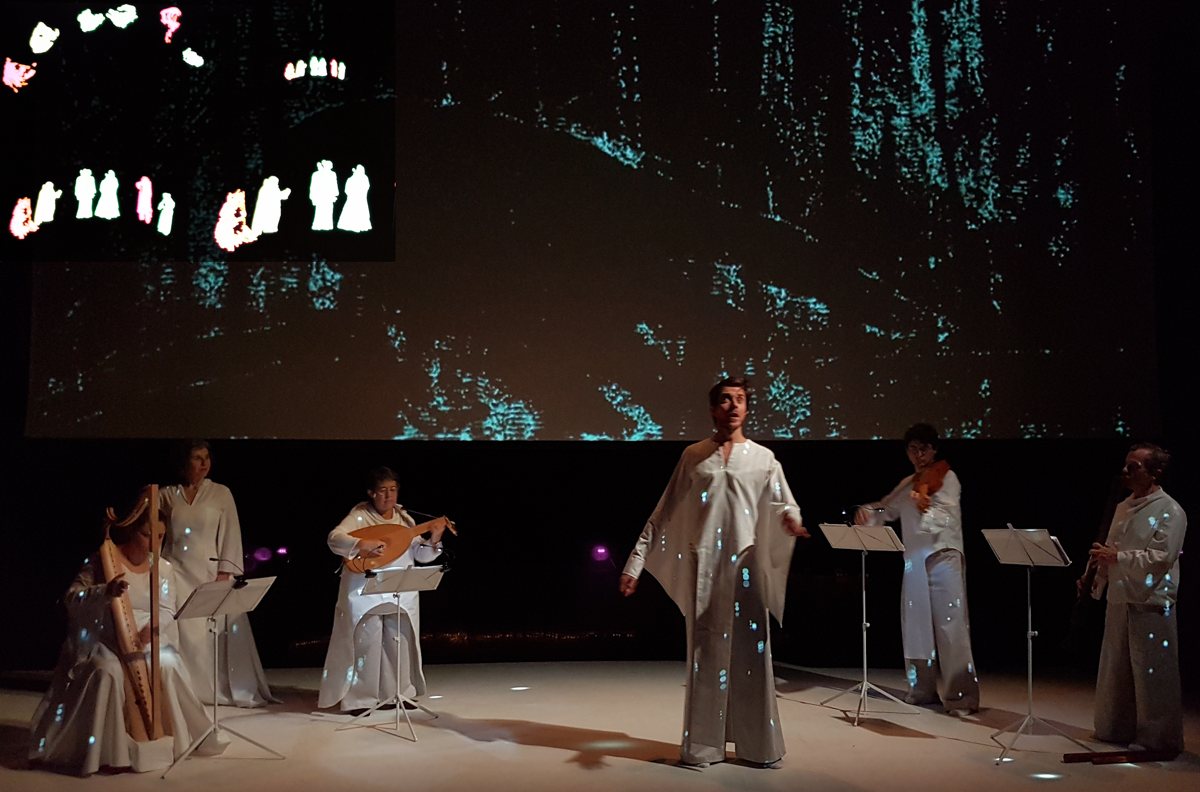
Figure 2. Scene around the drawing of Isabella d’Este (projected on the backdrop) with, superimposed, the real-time dynamic masks for video projection on the stage (top view, upper left) and on the six musicians (front view, lower left). The Louvre, Paris.
This text is a tribute to Denis Raisin Dadre, who gave this work its breath and keeps alive the music that Leonardo da Vinci loved to hear and to play.
Abstract (pdf, in French)
Poster (pdf)
