
1 LISN, Université Paris-Saclay, CNRS · 2 BioMaps, Université Paris-Saclay, CEA, CNRS · 3 Cervval, Brest · 4 La métonymie, Le sas
Paper presented at EuroXR 2025, the 22nd International Conference of the European Association for eXtended Reality, in Winterthur, Switzerland, 3–5 September 2025, in the scientific session Interaction Techniques. It received an Honorary Mention in the Scientific Track Awards. Summary of the paper; the full text and the supplementary material can be downloaded at the bottom of the page.
Jane Austen’s Fibres – Ariadne’s Fibres at the Forum des Halles, 25 March 2026
Immersion is part of any human experience, whether it is governed by the contingent world or by artificial, virtual spaces. In the cultural sector, immersive technologies are increasingly employed in contemporary artworks, installations, exhibitions and live performances. In this paper, we present and compare four multi-user interactive digital art installations, which are characterised by their varying degrees of technical immersivity (VR headsets, 360-degree space, video wall with floor projection, or sphere projection), their sensing capabilities (hand and head tracking, centre of gravity and joint tracking, motion tracking and multi-touch), their inherent interactivity (single or multi-user interaction, human-machine interaction), and the supporting stimuli (audio, visual, or tactile). These installations were exhibited in different public environments (art gallery, third place/cultural centre, shopping mall, museum), where the subjective user experience of 532 volunteers was studied along different immersion factors (spatial presence, affordance, enjoyment, and cybersickness among others). The impact of user characteristics like gender, age and prior experience with immersive technology was also evaluated. While spatial presence increases with the technical immersivity of the installation, the results suggest that factors like affordance and realness are more impacted by aspects such as interaction design and installation aesthetics. The evaluated user characteristics were found to have little or no impact on the immersion experience.
Here, immersion refers to the user’s subjective experience, immersivity to the technical characteristics of an installation that can elicit it, and spatial presence to the feeling of “being there”, inside the mediated environment. The field study compares four multi-user interactive digital artworks presented to the public in open or semi-open venues.
Memory Box is a six-degrees-of-freedom virtual reality experience for up to eight simultaneous users, shown for six months at Galerie Joseph in Paris as part of the trans-media exhibition L’Expérience Monroe. Over 17.5 minutes, scenes from Marilyn Monroe’s childhood and early career unfold, narrated by her spirit, a shape-shifting particle cloud voiced by Stéphanie Sphyras. With hand tracking and no controllers, users can attract the cloud by making a fist or repel it with a stop gesture.
The L∞p is a cylinder, 11 m in diameter and 4 m high, that up to 20 people can enter at once. Fourteen video projectors project onto two 360-degree cylindrical screens and the floor; sixteen Kinect cameras track the users and sixteen loudspeakers provide spatialized sound. At the Ateliers des Capucins in Brest, it hosted for two months, free of charge, Spacetime Prospectives, a 20-minute experience about the arrow of time in thermodynamics, relativity and quantum physics, where users can make timelines vibrate, collide with planets or leave footprints on the floor.
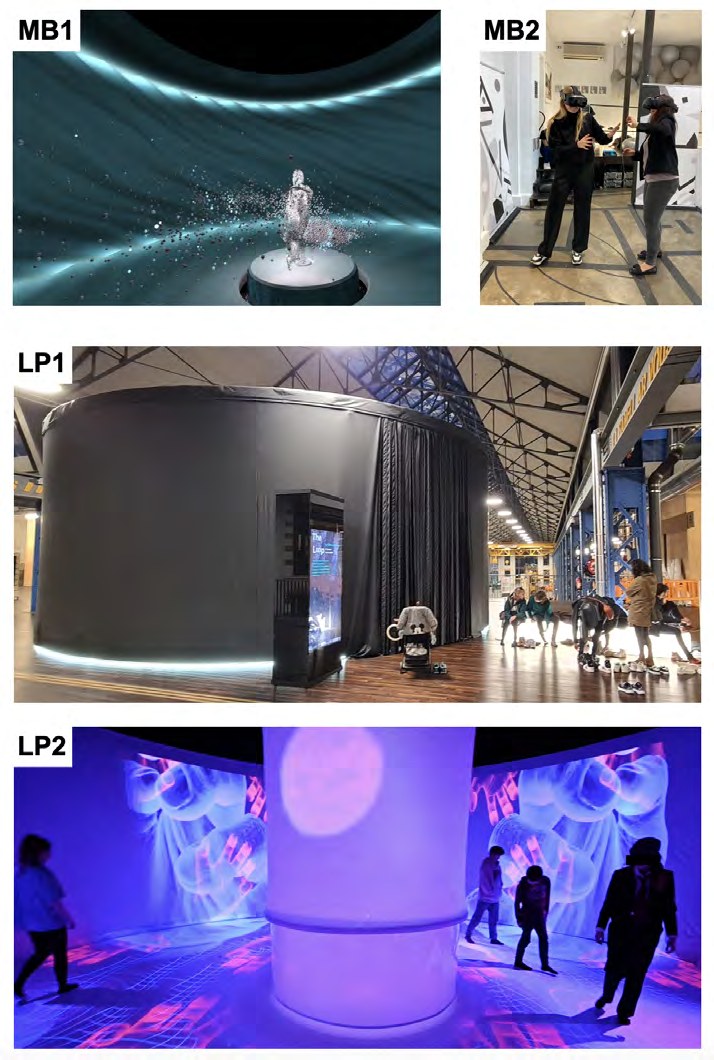
Figure 1. Memory Box and The L∞p. MB1: Marilyn Monroe’s spirit, represented as a particle cloud. MB2: users of Memory Box interacting with their hands; their gestures show that they are aware of each other. LP1: external view of The L∞p, with visitors taking off their shoes before entering. LP2: inside, users move around the central cylinder and warp a virtual grid under their feet.
Ariadne’s Fibres is a permanent artwork commissioned by the Forum des images and the City of Paris: a 5 × 4 m wall of eight 4K screens and a 7.7 × 4.8 m floor projection, in the shopfront of the Forum des images on the rue du cinéma of the Forum des Halles, freely accessible. In its idle state, a coloured background, a heat convection simulation and drops showing videos from the Forum’s programme blend together. Eleven Kinect cameras detect passers-by, whose avatars are made of anatomical fibres – nerves, blood and lymphatic vessels, muscles – whose appearance follows the weather and the seasons. Users push the drops around, spawn droplets from their nerve fibres and stir the convection with their own heat.
The Eye of the Sun is a motion- and touch-sensitive digital sculpture: two hemispheres about 1.6 m in diameter acting as a spherical screen for two internal video projectors. A giant eye stares at visitors, blinks, squints and follows them as they walk around it; to those who return its curiosity with the right gesture, it opens onto an interactive simulation of the surface of the Sun, based on images of the corona captured in the far ultraviolet by NASA’s SDO spacecraft. Sixteen infrared cameras detect motion around the eye and two wide-angle cameras detect hands on the sphere. It was shown in the apse of the church of Saint-Martin-des-Champs at the Musée des Arts et Métiers in Paris, for Nuit Blanche 2024 and the following two weeks.
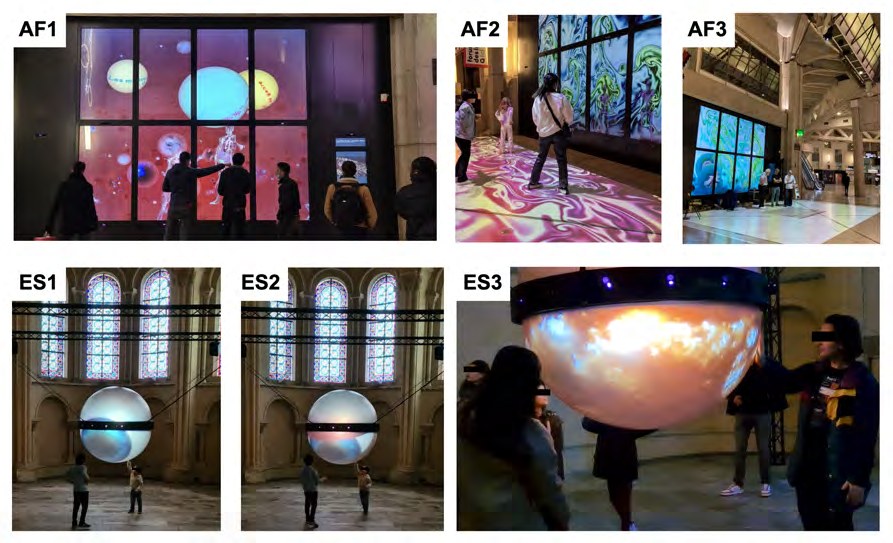
Figure 2. Ariadne’s Fibres and The Eye of the Sun. AF1: users interacting with their avatars and the many video drops and droplets. AF2: users and their avatars causing convection turbulences on the screens and on the floor. AF3: the video wall and floor projection during technical maintenance. ES1: young users interacting with the eye. ES2: the eye squinting after being touched. ES3: users exploring the surface of the Sun and causing coronal perturbations.
Participants were approached as they left each experience. Anonymous and voluntary, the questionnaire, in French or English, was completed on a tablet or phone in 8 to 12 minutes. 532 complete questionnaires were kept: 134 for Memory Box, 266 for The L∞p, 71 for Ariadne’s Fibres and 61 for The Eye of the Sun.
The immersive experience is measured with the SP-IE questionnaire (Khenak et al., 2019): 20 items and seven factors – spatial presence, affordance, enjoyment, realism, attention, cybersickness and social presence when avatars are present. Two modified versions, each without one item, make spatial presence and affordance more reliable. The predisposition to immersion is measured with the Immersive Tendencies Questionnaire (ITQ, Witmer & Singer, 1998), 18 items in four factors. Six hypotheses were tested with non-parametric Kruskal-Wallis and Mann-Whitney tests, with Bonferroni correction.
Spatial presence follows technical immersivity: highest for Memory Box, then The L∞p, Ariadne’s Fibres and The Eye of the Sun (Figure 3). Conversely, affordance and realism are highest for the two technically least immersive installations, The Eye of the Sun and Ariadne’s Fibres, with significant differences from Memory Box and The L∞p in almost all cases. Cybersickness is stronger in the two most immersive installations, and even slightly stronger in The L∞p than in virtual reality. Enjoyment and attention do not differ between installations.
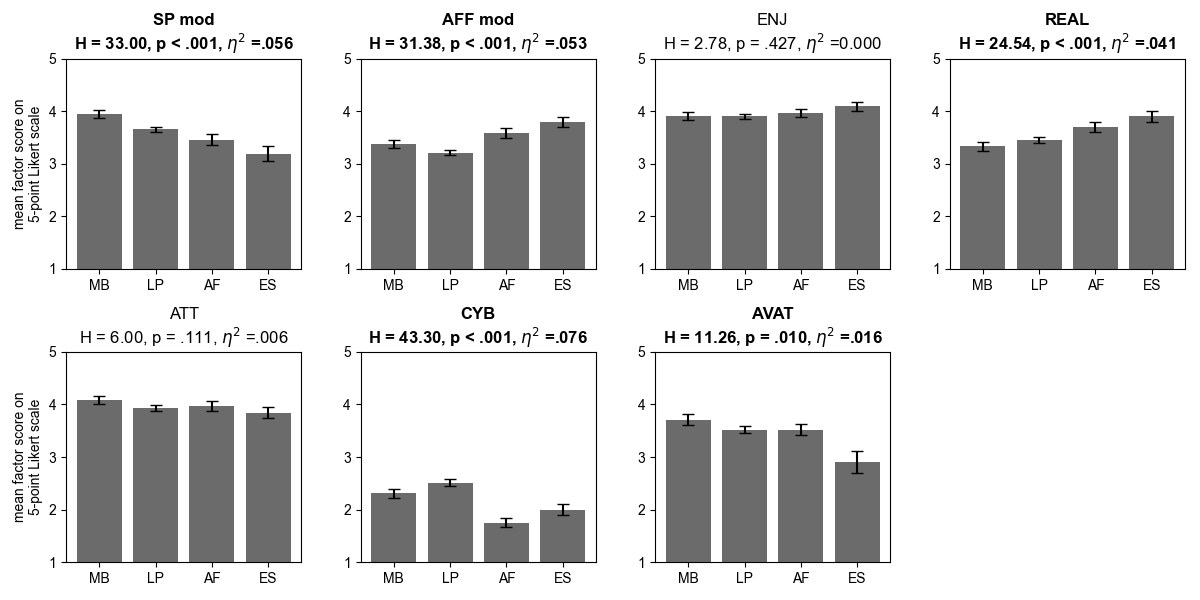
Figure 3. SP-IE factor scores for each installation (MB: Memory Box, LP: The L∞p, AF: Ariadne’s Fibres, ES: The Eye of the Sun). Bar height gives the group mean, error bars the standard error; the Kruskal-Wallis result is given in each title, in bold for significant differences.
User characteristics matter little. Age only has an effect in virtual reality, where older participants report lower affordance. Prior experience with immersive technology increases affordance and reduces cybersickness, especially for Memory Box. Differences between women and men appear mostly in The L∞p, where women report more spatial presence, enjoyment, attention and cybersickness. Immersive tendencies measured by the ITQ are only weakly correlated with the reported experience.
The stronger cybersickness in The L∞p may come from the movement of the projected objects, which contradicts the stillness felt by the feet and the inner ear, whereas Memory Box offers fixed virtual walls and floor. The Eye of the Sun and Ariadne’s Fibres are open installations without narration that respond immediately and clearly to gestures: the eye follows the visitor, the Sun ripples under the hand, the avatar mirrors every movement. Memory Box and The L∞p follow a storyline, with delayed reactions or reactions shared among many participants, to the point that users may lose track of what they triggered. An intuitive interaction design with direct feedback thus appears as one of the keys to a rich immersive experience.
In public spaces, people come across the artwork unexpectedly, share it with strangers, and move in and out freely. Co-presence, shared agency and environmental noise are not constraints to eliminate there, but parameters to design for.
The four installations differ in too many variables at once to isolate the cause of each effect, and the psychometric properties of the questionnaires could be improved. Future studies will combine questionnaires with behavioural data – trajectories, duration and intensity of interactions, emotion detection – and explore the understanding of interaction, avatar aesthetics, the role of narrative, and collaborative versus individual interaction.
This project has received funding from the European Union’s Horizon Europe research and innovation programme (grant agreement No 101061163) as part of the Artcast4D project. The authors thank Fayçal Bouiddou, Zohra Benmira and Nayeli Hulot for their help in collecting the questionnaires.
Paper (pdf)

Supplementary material (pdf)
