
Lung function lies at the heart of respiratory health. Respiratory diseases, one of the leading causes of death worldwide, are associated with our way of living and impact all of society. Yet current diagnostic and monitoring tools all fail, each in its own way, to fully assess lung structure and function: pulmonary function tests lack regional sensitivity, computed tomography involves ionising radiation, and conventional MRI remains costly.
V|LF-Spiro3D, a European EIC Pathfinder project coordinated by the BioMaps laboratory (Université Paris-Saclay, CEA, CNRS, Inserm), aims at democratising 3D MR spirometry: a ten-minute morphofunctional protocol, in free breathing, which yields a flow-volume curve at every point of the lung and thus reveals the localised ventilation defects that standard spirometry misses.

Lung dynamics in MRI: axial, coronal and sagittal slices along the breathing cycle
The consortium brings together four academic laboratories, four hospitals (Bicêtre, Erasmus MC in Rotterdam, Pitié-Salpêtrière and Foch) and two industrial partners (Siemens and NMR Service), in France, Germany, the Netherlands and the United Kingdom. More on the project website: www.v-lf-spiro3d.eu.
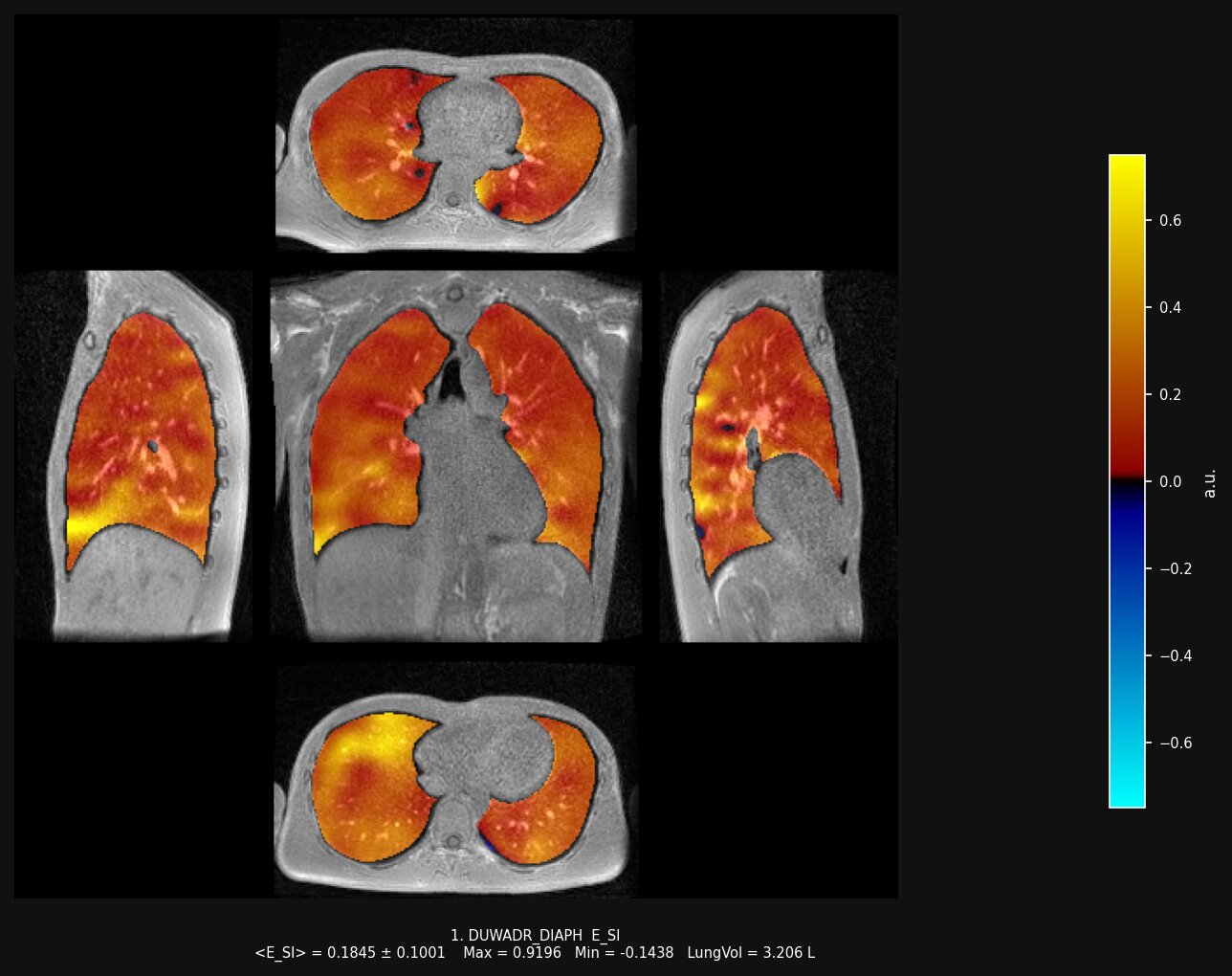
Regional map of lung ventilation in MRI
Beyond the technical feat, V|LF-Spiro3D questions what the technique does to those who receive and practise it. Work Package 4 (WP4), led by Le sas, supports philosophical and social research into the objectivation of 3D MR spirometry and the alienation it may induce in patients and practitioners alike. Does seeing a “curve which breathes” change how doctors and patients take ownership of the result? Can a person who sees their own lungs breathing see anything beyond a diagnosis? How do individuals and cultures react to this technology, and what part does breathing play in personality?
The specific objectives of WP4 are to:
3D lung surfaces along the breathing phases
Everything goes is the central work of WP4: a double mirror augmented by physiological rhythms, in which the three-dimensional reflection of visitors reveals their lungs breathing and the air passing through their bodies, built from the project’s MRI data and respiratory signals. Visitors appropriate their rhythms and can play with them. Everything goes thus becomes a testing ground for the influence of this virtual self on our behaviour, where the technique attaches itself directly to our physiology, where everything goes.
Everything goes was previewed at the Cité des sciences et de l’industrie during Being at breath (NewImages Festival, April 2026), then created on 2 August 2026 at Aberdeen Art Gallery as part of Breathing Bodies, alongside Primary Intimacy of being.
Organised by the V|LF-Spiro3D consortium with the support of the University of Aberdeen, the EU Chest MRI Advanced School took place from 15 to 17 September 2026. It brought together researchers, clinicians, students, industry partners, NHS consultants, anthropologists, radiographers and patients around lung anatomy, physiology and function, and recent developments in high- and low-field MRI. The Breathing Bodies exhibition extended its questions into public space, across the city of Aberdeen.
Everything goes, from its first trials at Le sas to Aberdeen Art Gallery.
Everything goes at Aberdeen Art Gallery, Breathing Bodies, August 2026
Everything goes at the NewImages Festival, Cité des sciences, April 2026
Everything goes inflates at Le sas, February 2026
Everything goes breathes hard
Two lungs breathe
A red line
Another line altogether
A line, under construction
[Coordination] Xavier Maître, BioMaps (Université Paris-Saclay, CEA, CNRS, Inserm)
[Project management] Nicola Lorè
[WP4 | Art-science] Ikse Maître, Le sas
V|LF-Spiro3D has received funding from the European Union’s Horizon Europe research and innovation programme (European Innovation Council, EIC Pathfinder) under Grant Agreement No 101099934 (April 2023 – March 2027), and from Innovate UK.
